
Understanding walnuts
How Much Kernel Do In-Shell Walnuts Yield?
Kernel yield is usable kernel weight divided by starting in-shell weight. If 1,000 g of in-shell walnuts produces 450 g of usable kernels, that sample yields 45%. It is not a guarantee for the entire pack.
Take two separate measurements
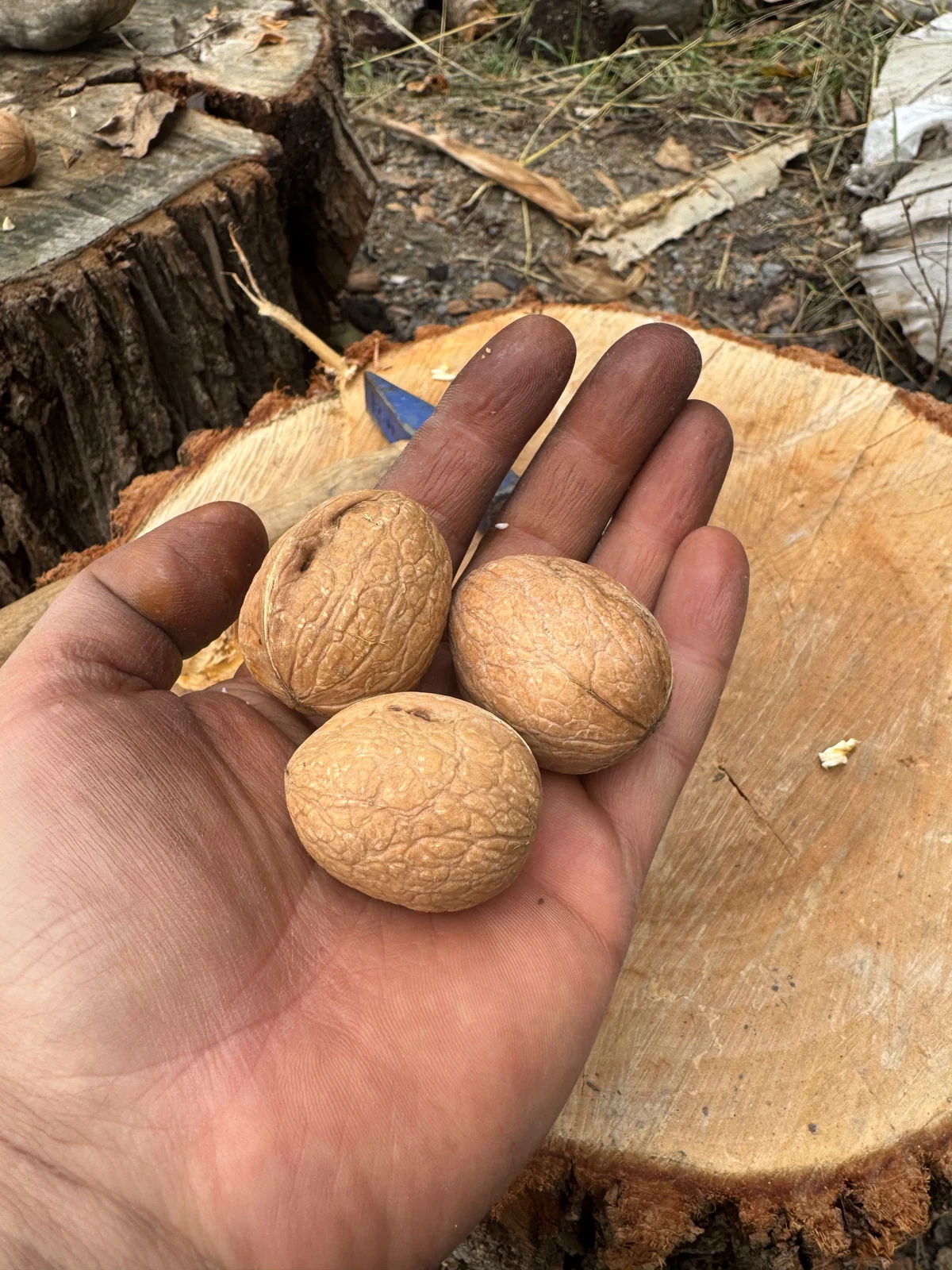
Zero your scale with an empty bowl. Weigh a group of walnuts taken from different parts of the pack and record the result. Choosing only the largest nuts can give an unrepresentative sample.
Crack them and carefully remove shells and hard internal partitions. Weigh the usable kernels separately. Whole halves and usable small pieces both count: this measures quantity, not presentation.
Apply the simple formula
Usable kernel weight ÷ in-shell weight × 100. Use the same unit for both measurements: 450 ÷ 1,000 × 100 = 45%.
The result can vary with the variety, individual nut fill and pieces removed during preparation. A handful of nuts does not establish a fixed yield for an entire harvest.
Estimate the amount needed for a recipe
If a recipe needs 200 g of kernels and your sample yielded 45%, 200 ÷ 0.45 suggests about 445 g of in-shell walnuts. This is a preparation estimate; weigh the kernels again once shelled.
Using the same assumption, 20 kg could give approximately 9 kg of kernels. The 45% figure is only a calculation example, not a yield promise for a Ceviz Vadisi pack or variety.
Compare like with like
Do not equate the kilogram price of in-shell walnuts with that of ready-shelled kernels. Actual usable quantity, shelling effort and the piece size needed for your dish all matter.
Keep a note of your sample weights for your next purchase. A dish requiring intact halves has different needs from a recipe using ground walnuts.
Make your measurements repeatable
Subtract the empty container’s weight each time. If you use different bowls for in-shell nuts and kernels, do not assume the bowls weigh the same. Weigh the same sample twice to check that the scale settles consistently. Always record the unit to avoid mixing grams and kilograms.
For a more useful personal comparison, take several samples from different parts of the pack. Divide their combined usable kernel weight by their combined in-shell weight. If sample sizes differ, combining weights is more appropriate than simply averaging their percentages. Record the variety and measurement date so later purchases can be compared with the same method.
Frequently asked questions
Does a large nut always give more kernel?
External size alone is insufficient. Weigh the usable kernel after shelling.
Do small pieces count?
Usable small kernel pieces count. Shell and hard internal partitions do not.
Sources
An original shopping and calculation guide by Ceviz Vadisi. See the relevant product page for prices and product information.