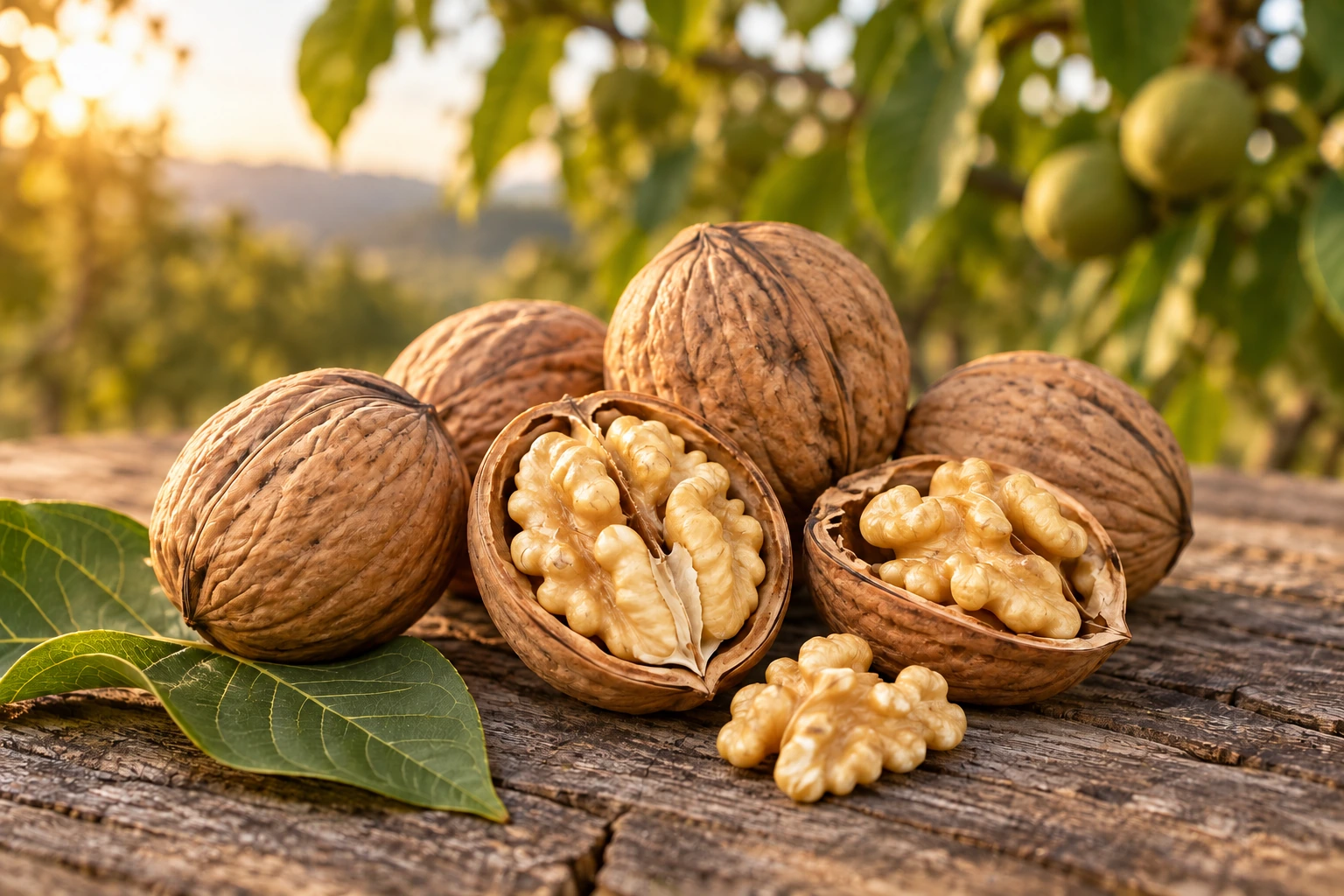

Choosing walnuts
How to Choose Quality Walnuts: 5 Tips for Local and Imported Nuts
No single sign proves walnut quality. Assess product information, intact shells, full kernels and a normal smell together. Shape, colour or a floating test cannot reliably identify the country of origin.
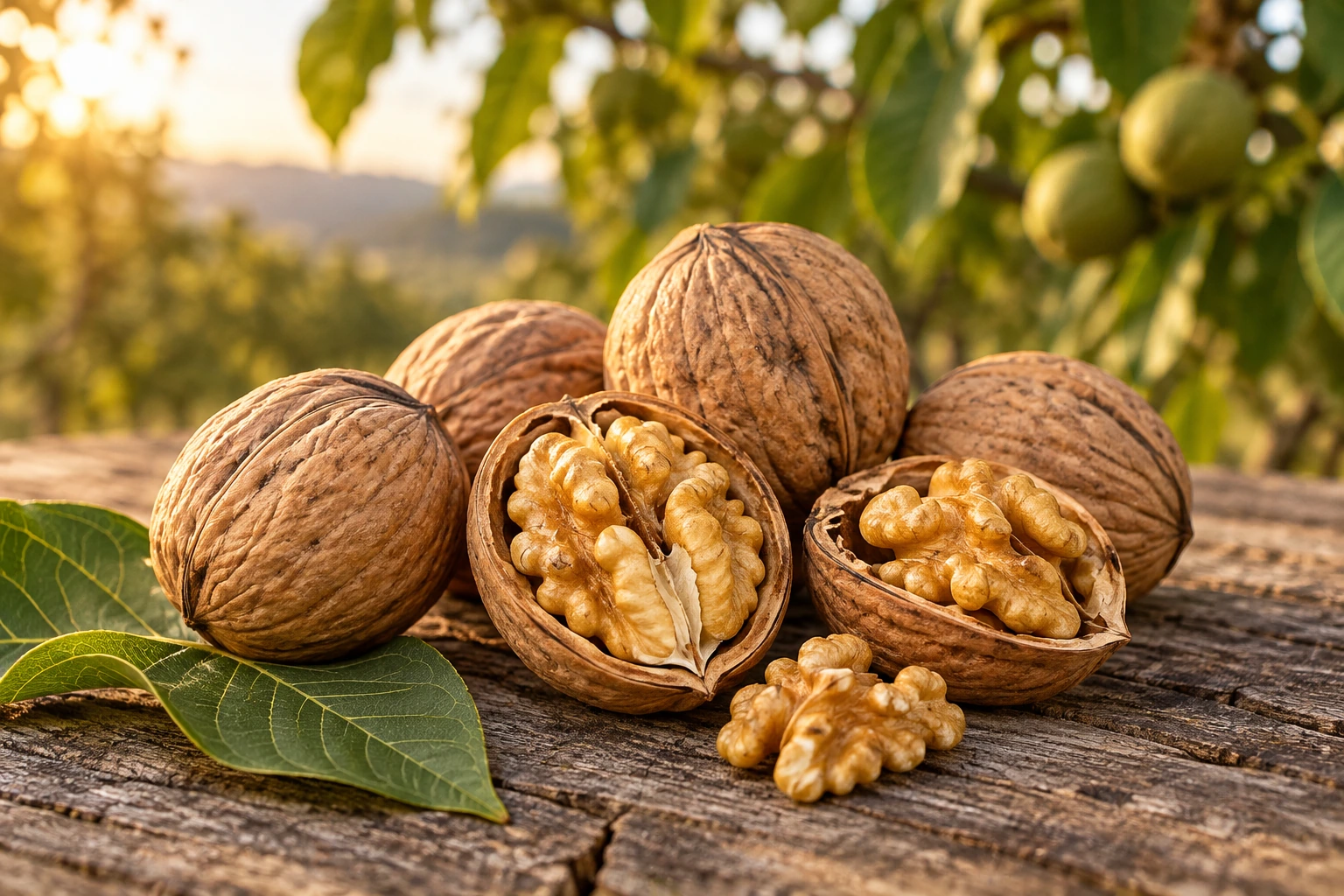
1. Ask about origin and the current batch
‘Local’ refers to where a product was grown; ‘fresh’ describes the condition of the batch you buy. Buying from a local grower may make it easier to discuss the orchard and product history. Origin alone, however, is not a quality ranking: well-stored imported walnuts can also be good.
Ask where the walnuts were grown, which variety they are, when they were harvested and how they were stored. Online, read the description and contact details as well as looking at the main image. Clear, consistent answers are more useful than visual guesses.
2. Examine the shells
Look for broken areas, holes, foreign material and visible mould. A particularly pale or dark shell does not, on its own, establish quality. Shell hardness also varies with variety; a hard-to-crack walnut is not automatically stale.
US in-shell walnut standards assess external defects, internal defects and kernel colour separately. This illustrates why a large shell alone tells you too little. [1]
3. Open more than one sample
Inspect several walnuts from different parts of a pack. A large-looking shell may contain less kernel than you expect. Look at empty space, shrivelling and the usable amount, then weigh the kernels in the same container.
If a 100 g in-shell sample gives 50 g of usable kernels, the kernel percentage for that small sample is 50%. This is not a guarantee for the entire pack, but it is a simple way to compare two samples using the same method. Pieces lost or discarded during shelling affect the result.
4. Consider smell and taste together
Do not use a walnut with a distinctly stale-oil smell or an unpleasant bitter flavour. Rancid nuts can develop an unwanted smell and taste. [2] Do not taste a visibly mouldy walnut to test it; mouldy nuts should be discarded. [3]
A plain sample tells you more about flavour than walnuts hidden in a sweet or strongly spiced recipe. Photographs cannot communicate smell or taste, which is another reason to discuss your questions directly with the producer before ordering.
5. Compare price against your intended use
Do not compare the price per kilogram of in-shell walnuts directly with the price of shelled kernels. Shelling time, kernel yield and the piece size your recipe needs all affect the decision. If you do not need decorative halves, appearance alone need not drive your choice.
Ceviz Vadisi offers the same pack sizes for Maraş 18 and local walnuts. Choose a variety and quantity, then ask for the current price. Buy an amount that fits your consumption and storage plan instead of leaving a large supply in a warm kitchen.
Frequently asked questions
Can a water test show that a walnut is locally grown?
No. Floating or sinking does not verify its country or variety. Use product information and traceable records to establish origin.
Are light kernels always fresher?
No. Colour alone cannot prove the harvest date or storage quality. Look at the shells, kernels and product history together.